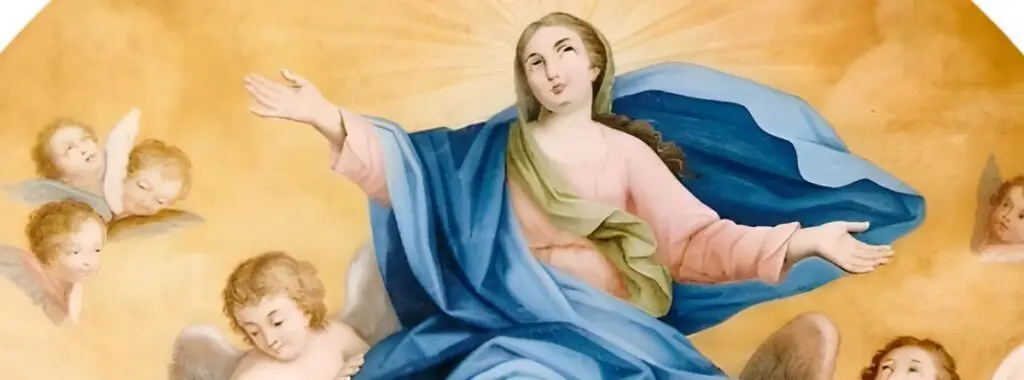
On November 1, 1950, Pope Pius XII defined the Assumption of Mary into heaven as a dogma of Catholic Faith. This teaching was formally declared in the Apostolic Constitution Munificentissimus Deus.
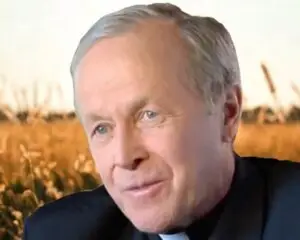
To explore and better understand the Assumption of Our Lady into heaven, we spoke with Fr. Robert Maloney, CM, a past superior general of the Congregation of the Mission. Fr. Maloney has written extensively about understanding the Vincentian charism. His most recent book, St. Vincent de Paul and Devotion to Mary: The Founder’s Gift to the Vincentian Family Yesterday and Today, focuses on St. Vincent de Paul’s view of Mary, and how Marian devotion developed in the Vincentian Family.
Q: Can you explain what “Assumption of Mary into heaven” means, and why it is an important Catholic belief?
A: In the simplest terms, we believe that Mary, at the end of her life, became what all of us hope to become: fully united with God in her whole person, body and soul.
The Catholic Catechism expresses our belief in this way (art. 966):
“Finally the Immaculate Virgin, preserved free from all stain of original sin, when the course of her earthly life was finished, was taken up body and soul into heavenly glory, and exalted by the Lord as Queen over all things, so that she might be the more fully conformed to her Son, the Lord of lords and conqueror of sin and death. The Assumption of the Blessed Virgin is a singular participation in her Son’s Resurrection and an anticipation of the resurrection of other Christians.”
Q: What led Pope Pius XII to officially declare the dogma of the Assumption of Mary into heaven? And why did he declare it?
A: After Pius IX’s definition of the dogma of the Immaculate Conception in 1854, Marian devotion increased and people began to reflect more deeply on the meaning of this newly defined “mystery” in Mary’s life. We still use this “mystery” terminology when we speak of the Rosary. It means events whose meaning we ponder over in the life of Christ or Mary or the Church.
Catholics knew that from early times in the history of the Church, Christians had celebrated Mary’s Assumption into heaven. They regarded it as something that flowed from her sinlessness. After the definition of the Immaculate Conception, focus on the Assumption increased.
A popular movement to have it defined as a dogma began to swell up. Pius XII recognized this. In 1950, he described in Munificentissimus Deus the extensive consultation process that he undertook before declaring the Assumption an article of faith. The actual statement of the dogma was careful and concise: “… we pronounce, declare, and define it to be a divinely revealed dogma: that the Immaculate Mother of God, the ever Virgin Mary, having completed the course of her earthly life, was assumed body and soul into heavenly glory.”
The statement, which came at the conclusion of a long document, deliberately avoided some disputed questions.
Q: Mary’s Assumption into heaven is not told in the Bible, so how did that belief develop and become dogma?
A: As time goes on and people meditate on the scriptures, they see new things and draw conclusions that they know are not explicitly in the scriptures, but which they believe flow from reflection on the Word of God. Theologians call this “the development of doctrine.”
Q: Can you tell us how Mary’s Assumption into heaven is different than Jesus’ Ascension into heaven?
A: It’s crucial to keep Marian truths and Marian devotion in a separate category from truths about Jesus. A central article of our faith is that Jesus is truly God and truly human, while our faith professes that Mary is utterly human, even if preserved from sin by the gift of God. The use of the English words “Ascension” and “Assumption” attempts to convey that distinction. Not all languages have this distinction.
Q: How does Mary’s Assumption into heaven help Catholics picture and trust what God has promised for them after death?
A: That is precisely the dogma’s strong point. “We believe in the resurrection of the dead [that of others and our own] and in the life of the world to come.” We believe that Mary in her full humanity (body and soul) already lives that life to its fullest. We hope that we will, too.
When we try to picture that life, imagination fails us. Other questions arise that future generations will reflect on and try to respond to. Does Mary now possess what everyone else hopes for in the future? We rarely reflect on “intermediary states” (which the dogma excludes for Mary), but what about for us? Is the “resurrection of the body” something immediate for us? Is “cleansing from sin” (excluded in Mary), which we commonly call purgatory, part of the dying process for the rest of us? How does our earthly body, which fades away into dust, relate to the “spiritual body” which endures?
In the first century, Paul was already grappling with this puzzling problem in his first letter to the Corinthians 15:44: “It is sown a natural body; it is raised a spiritual body. If there is a natural body, there is also a spiritual one.” Is there a maturing process between the moment of death and the final resurrection? Does the resurrection of the body complete the transformation of the world as a new heaven and a new earth (a question with ecological implications)?
Spend time with Our Lady while meditating upon the mysteries of the Rosary with the Daughters of Charity on our website. Learn more about the Central Association of the Miraculous Medal and the various ways to support us.
To read more from Fr. Maloney, discover his book, St. Vincent de Paul and Devotion to Mary: The Founder’s Gift to the Vincentian Family Yesterday and Today on Amazon.